Showing posts with label © Musicroom's Imaging. Show all posts

Sunday, April 28, 2013

Shikra


Description

     The Shikra (Accipiter badius) is a small bird of prey in the family Accipitridae found widely distributed in Asia and Africa where it is also called the Little Banded Goshawk. The African forms may represent a separate species but have usually been considered as subspecies of the Shikra. The Shikra is very similar in appearance to other sparrowhawk species including the Chinese Goshawk and Eurasian Sparrowhawk. They have a sharp two note call and have the typical flap and glide flight. Their calls are imitated by drongos and the Common Hawk-Cuckoo resembles it in plumage. 


     The Shikra is a small raptor (26–30 cm long) and like most other Accipiter hawks, this species has short rounded wings and a narrow and somewhat long tail. Adults are whitish on the underside with fine rufous bars while the upperparts are grey. The lower belly is less barred and the thighs are whitish. Males have a red iris while the females have a less red (yellowish orange) iris and brownish upperparts apart from heavier barring on the underparts. The females are slightly larger. The mesial stripe on the throat is dark but narrow. In flight the male seen from below shows a light wing lining (underwing coverts) and has blackish wing tips. When seen from above the tail bands are faintly marked on the lateral tail feathers and not as strongly marked as in the Eurasian Sparrowhawk. The central tail feathers are unbanded and only have a dark terminal band. Juveniles have dark streaks and spots on the upper breast and the wing is narrowly barred while the tail has dark but narrow bands. A post juvenile transitional plumage is found with very strong barring on the contour feathers of the underside. The call is pee-wee, the first note being higher and the second being longer. In flight the calls are shorter and sharper kik-ki ... kik-ki. The Chinese Sparrowhawk is somewhat similar in appearance but has swollen bright orange ceres and an yellow legs while the wing tips are entirely black.


Behavior, feeding and habitat

    Several subspecies are recognized across its range and some of them may be treated as full species. It has been suggested, based on differences in morphology and calls, that the African forms do not belong to this species.Subspecies cenchroides (Severtzov) is larger and paler and found in Turkestan, Afghanistan and eastern Iran. The Indian population dussumieri is resident on the plains and lower hills (up to 1400 m in the Himalayas). The nominate form is found in Sri Lanka and has somewhat darker grey upperparts. The Burmese Shikra A. b. poliopsis may represent a distinct species. The population on Car Nicobar Island, earlier treated as a subspecies butleri and that on Katchall Island, obsoletus are now treated as a sub-species within a full species, the Nicobar Sparrowhawk (Accipiter butleri).The west African population A. b. sphenurus is migratory while the southern African A. b. polyzonoides is more nomadic in its movements. In Asia only A. b. cenchroides is migratory.


     The Shikra is found in a range of habitats including forests, farmland and urban areas. They are usually seen singly or in pairs. The flight is typical with flaps and glides. During the breeding season pairs will soar on thermals and stoop at each other. Their flight usually draws alarms among smaller birds and squirrels. They feed on rodents (including Meriones hurrianae), squirrels, small birds, small reptiles (mainly lizards but sometimes small snakes) and insects.Small birds usually dive through foliage to avoid a Shikra and a Small Blue Kingfisher has been observed diving into water to escape. Babblers have been observed to rally together to drive away a Shikra. They will descend to the ground to feast on emerging winged termites, hunt at dusk for small bats (such as Cynopterus sphinx) and in rare instances they may even resort to feed on carrion. In one instance a male was found feeding on a dead chick at the nest. Their calls are mimicked by drongos and this behaviour is thought to aid in stealing food by alarming other birds that the drongos associate with.The breeding season in India is in summer from March to June. The nest is a platform similar to that of crows lined with grass. Both sexes help build the nest, twigs being carried in their feet. Like crows, they may also make use of metal wires.The usual clutch is 3 to 4 eggs (when eggs are removed they lay replacements and one observer noted that they could lay as many as 7 in a season) which are pale bluish grey stippled on the broad end in black. The incubation period is 18 to 21 days.The Shikra was a favourite among falconers in India and Pakistan due to the ease with it could be trained and was frequently used to procure food for the more prized falcons. They were noted for their pluck and ability to take much larger birds including partrigdes, crows and even young peafowl. The word shikra orshikara means hunter in the Hindi language (the male was called chipak or chipka based on call) and was used in the French name Le Chicquera which was however given to theRed-necked Falcon by Levaillant in 1799. An Indian Navy's helicopter base was named INS Shikra in 2009. The shikra is also the mascot for the 149 Squadron of the Republic of Singapore Air Force, which operates the F5S/T Tiger IIs fighter jets.


     This was a fantastic phenomenon to watch in the evening, all of the images being full frame and no cropping done on any of them. I had a doubt about the Female Shikra venturing into a Greater Racket Tailed Drongo's nest, due to which this Shikra was trying to hide from the Drongo. There was a Drongo on the top branch which almost came chasing this Shikra from quite far distance. I missed the action when Drongo dived on the Shikra's head to shoo it away from this place, when the Shikra screamed a loud "keee-keee" and fled the scene. I was sitting as usual in the evening expecting the Yellow Footed Green Pigeons to arrive on the Tamarind tree, when I had a glance of this action in the adjacent tree, right in front of me. This perch was a very congested one for the Shikra to take refuge, after taking several rounds to sit comfortably it couldn't find itself fitting inside the two Y-shaped branches, so rightly the Drongo attacked on its head for it to disappear from here. I was on a Canon EOS 300mm F4L IS USM with a Tamron 1.4x extender, mounted on Canon EOS 7D SLR, such that I could get this close-up and full frame images, satisfying me for the superb evening observation.


Monday, April 15, 2013

Black Stream Glider


Description

     The Black Stream Glider (Neurothemis fulvia) is a species of dragonfly found in India and nearby continents.Black Stream Glider or Trithemis festiva is a medium sized dragonfly with purple color on its body structure.In the Male, the frontal area appears darker purple-ish grey. The eyes are dark brown above, with a purple colored tinge, which is blue-ish grey, lateral and beneath. The Thorax is Black, covered with purple pruinescence, which helps it appear deep blue. The Legs are black and wings are transparent with a dark opaque brown mark at the base of hind wing, with a black spot on tip of the wing. The abodomen is covered with fine blue pruinescence.


     The Female looks dirty brown in the front and extends above. The eyes are dark brown above and appear more grey-ish below. Thorax is Greenish Yellow to Olivaceous, with the presence of a medial dark brown lateral stripe. In addition, a Y-shaped inverted stripes can be observed on the sides. Legs are Black with anterior femora being yellow on the inner side. 


     Wings are transparent with dark reddish-brown tip with a black spot, similar to the Male. Abdomen appears bright yellow with medial, lateral and ventral stripes, colored black, however, the medial and lateral black stripes form a confluence at abdominal segments to enclose a wedge-shaped yellow spot.Size: Male: Abdomen: 22-28mm, Hind wing: 26-32mm. Female: Abdomen: 21-24mm, Hind wing: 29mm.


Behavior, feeding and habitat

     This dragonfly is commonly seen and has been mostly observed near slow flowing streams and canals, accompanying dense forest ranges. It usually perches on boulders adjacent to streams, rivers and canals. They have also been witnessed perched on tip of aquatic plants, dried plants and similar plants that grow near banks of a sluggish steam or river. 


    They have been observed to be little shy to human beings approaching them, however they are good observers of human beings. Even though people don't notice them, but these dragonflies watch the activities of human beings near them. Its flight activity is at the peak between May and November, but can be seen in other seasons only in quite small numbers, throughout oriental regions. 


     I am happy to contribute an article on this dragonfly, to Wikipedia which has never been recorded before by anybody in this world. Luckily I am the first person to create and list this dragonfly to the world for reference. I am thankful to my friends Ajith Kamath and Ranganath Bhat for choosing Someshwara as location for birding, where we could witness this beautiful living phenomenon of nature, right on the banks of Sita River.

Long Legged Marsh Glider


Description

     The Long Legged Marsh Glider (Neurothemis fulvia) is a species of dragonfly found in India and nearby continents.Long Legged Marsh Glider or Trithemis pallidinervis is a medium sized yellowish brown dragonfly with long legs that resembles more like spider's legs.


     In the Male, the face is yellow or pale brown in front and iridescent purple above. The eyes are colored Reddish brown above, brown on sides and bluish grey below. The Thorax is Olivaceous-brown above with a dark brown triangle. On sides, it is bright yellowish brown with three black stripes on each side. Legs are Black in color, long and spidery. The basal half of femora of first pair of legs are bright yellow. The Wings are transparent with reddish venation. The forewings have amber coloured basal markings. The wings have a golden sheen when viewed from certain angle. Wing spot is black with creamy white ends. The Abdomen looks Bright yellow in color with black median and lateral stripes. These stripes are confluent at the end of each abdominal segment to enclose a wedge shaped yellow spot. The male varies in colour from yellow (below) to chocolate brown and is easily distinguished by its long legs and wings that point upwards.


     Female resemble the male and wings are often tinted with yellow or reddish brown. The base of abdomen is broadly black. Size: Male: Abdomen: 28-32mm, Hind wing: 30-36mm. Size: Female: Abdomen: 26-28mm, Hind wing: 30-32mm.


Behavior, feeding and habitat

     This dragonfly is seen near marshes and weedy ponds. It usually perches on tall aquatic weeds or bare ends of shrubs. The long legs are very clearly noticeable at this time. They are also seen near streams, rivers and good sources of water, especially near rivers flowing through forests. It has been observed from many instances to be not much scared of human beings, hence its easier to photograph them. 


     It was observed to have stayed for a long time without moving an inch from its perched spot, especially on bare ends of shrubs. It is seen in plenty in the months of October-December, though could be seen at other times, but not as much in count, as seen through October- December.


     I am happy to contribute an article on this dragonfly, to Wikipedia which has never been recorded before by anybody in this world. Luckily I am the first person to create and list this dragonfly to the world for reference. I am thankful to my friends Ajith Kamath and Ranganath Bhat for choosing Someshwara as location for birding, where we could witness this beautiful living phenomenon of nature.

Sunday, April 14, 2013

Greenish Warbler


Description

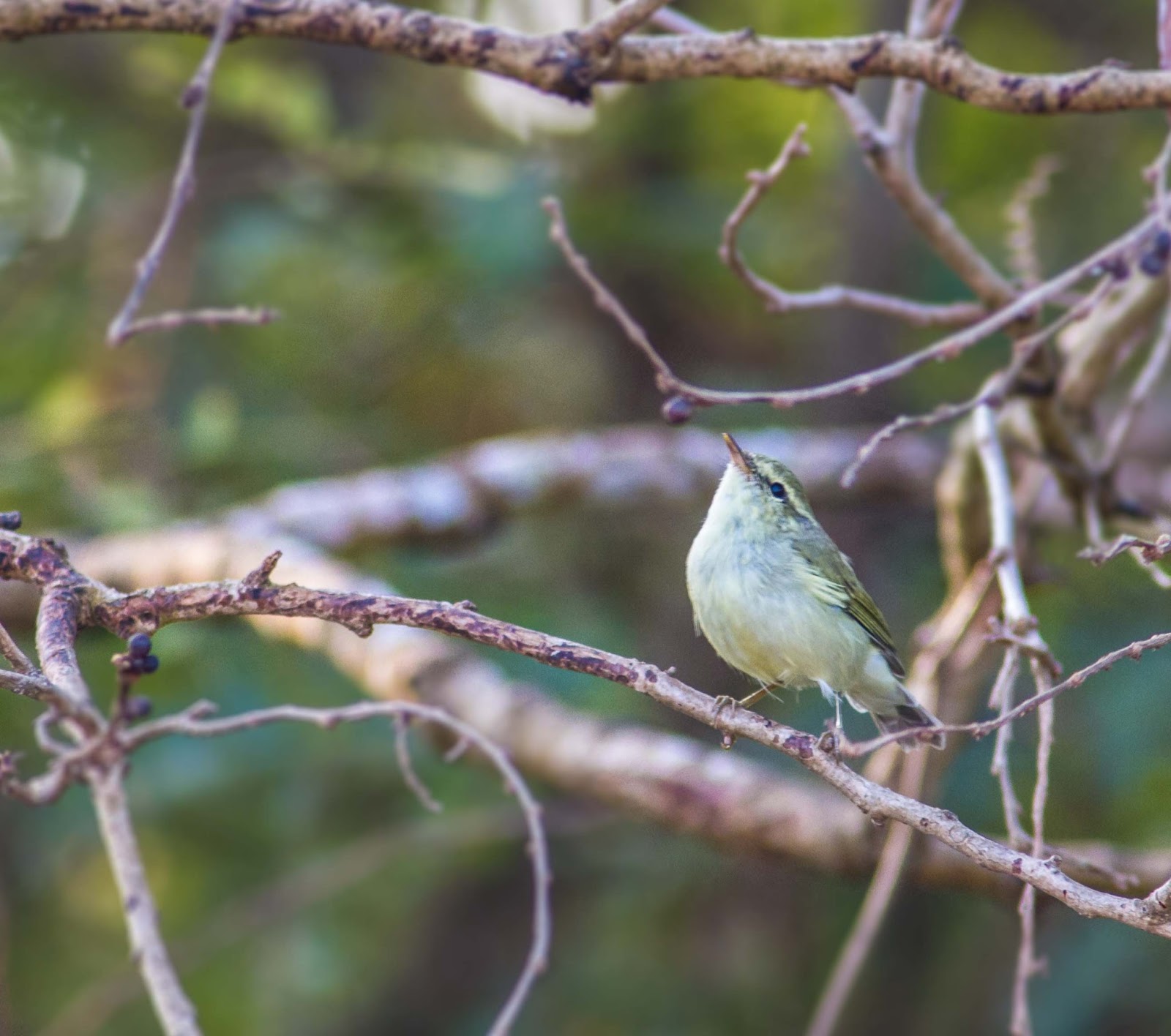
     The Greenish Warbler (Phylloscopus trochiloides) are widespread leaf warblers throughout their breeding range in northeastern Europe and temperate to subtropical continentalAsia. This warbler is strongly migratory and winters in India. It is not uncommon as a spring or early autumn vagrant in Western Europe and is annually seen in Great Britain. InCentral Europe large numbers of vagrant birds are encountered in some years; some of these may stay to breed, as a handful of pairs does each year in Germany.Like all leaf warblers, it was formerly placed in the "Old World warbler" assemblage, but now belongs to the new leaf-warbler family Phylloscopidae.This is a typical leaf warbler in appearance, grayish-green above and off-white below. The single wing bar found in the southern and western populations distinguishes them from most similar species (except Arctic Warbler P. borealis). It is slightly smaller than that species and has a thinner bill, without a dark tip to the lower mandible


     A latitude-based analysis of wintering birds indicated that more northerly P. trochiloides are smaller, i.e. this species does not seem to follow Bergmann's ruleIts song is a high jerky trill, in some populations containing a sequence of down- and more rarely up slurred notes.It breeds in lowland deciduous or mixed forest; non-breeding birds in the warmer parts of its range may move to montane habitat in summer. Individuals from southeast of the Himalayas are for example quite often seen in Bhutan during the hot months, typically in humidBhutan Fir (Abies densa) forest up to about 3,800 meters ASL or more, but they do not breed there and return again to the adjacentsubtropical lowlands in winter.The nest is on the ground in low shrub. Like its relatives, this small passerine is insectivorous.


Behavior, feeding and habitat

     It has a number of subspecies, of which P. t . viridianus is the most familiar in Europe. As it seems, it is a ring species, with populations diverging east- and westwards of theTibetan Plateau, later meeting on the northern side. Their relationships are therefore fairly confusing:

  • Eastern group: Greenish Warblers
    • Phylloscopus trochiloides trochiloides: Greenish Warbler
      • Southern rim of the Himalaya eastwards from Nepal into W China.
      • Dusky greyish green above, often traces of second wing bar.
    • Phylloscopus trochiloides obscuratus: Dull-green Warbler
      • Intermediate between trochiloides and plumbeitarsus.
      • Gansu and surroundings, China.
    • Phylloscopus trochiloides plumbeitarsus: Two-barred Warbler or Grey-legged Leaf Warbler
  • Western group: Green Warblers
    • Phylloscopus trochiloides viridanusWestern Greenish Warbler
      • Breeds Western Siberia to north-east Europe; at east of range south to NW India.
      • Dull green above, with yellowish supercilium, throat, breast and faint wing bar.
   

    The groups' origin lies probably in the Himalayan region, where trochiloides is found. This taxon is close to the parapatric obscuratus, and to plumbeitarsus which is geographically separated from obscuratus; they all can (and in the case of the former two do naturally) hybridizeP. t. plumbeitarsus is often split as distinct species, as it does not hybridize withviridianus in the narrow zone in the western Sayan Mountains where their ranges overlap. Song structure differs mainly between trochiloides and plumbeitarsus. The former has a fairly uniform, long, and warbling song.


   Around the Himalayas, song structure is similar, but songs are generally shorter. plumbeitarsus, on the other hand, has a long song that can be clearly divided into a warbling part, followed by series of up- and downslurred notes. The songs of obscuratus, and, interestingly, "ludlowi", are short, but contain the downslur elements too; in the latter, they uniquely appear at the start of the song.But phylogenetically, the western taxa are even more distinct. However, there is some gene flow between trochiloides and viridianus also, with their hybrids being especially common inBaltistan; they were once considered another subspecies ludlowi. The Green Warbler P. nitidus, now by many considered a distinct species, is a mountain isolate that diverged from ancestral viridianus.


     Amazing bird to watch, quite sharp and hyper-active one, found early morning around 7:15 am, clicked at the terrace, from the trees opposite to our house in Kulai, Mangalore. This time, this bird was not in much mood for hyper-activity, it was sitting silently making its routine "chirr"ing call from the tree. I am lucky to get this shot, whilst happily getting a shot before brushing my teeth in the morning. This beauty made my day a rocking one, as watching birds motivate me more than my music. Its very shy by its behaviour and it was difficult for me to get full frame images, as this was quite a little far, hence I have managed to get 1/4th cropped images of this spectacular bird. I was trying my new Canon EF 300mm F4L IS USM Lens, on my Canon EOS 7D, whereby I hadn't yet bought the 1.4 extender, which made this a little farther to my viewfinder.

Saturday, March 30, 2013

Praying Mantis


Description

     Mantodea (or mantisesmantes) is an order of insects that contains over 2,400 valid species and about 430 genera in 15 families worldwide in temperate and tropical habitats. Most of the species are in the family Mantidae.The English common name for any species in the order is "praying mantis", because of the typical "prayer-like" posture with folded fore-limbs, although the eggcorn "preying mantis" is sometimes used in reference to their predatory habits. In Europe and other regions, the name "praying mantis" refers to only a single species, Mantis religiosa. The closest relatives of mantises are the termites and cockroaches (order Blattodea). They are sometimes confused with phasmids (stick/leaf insects) and other elongated insects such asgrasshoppers and crickets.The name of the order mantodea is formed from the Ancient Greek words Î¼Î¬Î½Ï„ις (mantis) meaning "prophet", and Îµá¼¶Î´Î¿Ï‚ (eidos) meaning "form" or "type". It was coined in 1838 by the German entomologist Hermann Burmeister.The systematics of mantises have long been disputed. Mantises, along with walking sticks, were once placed in the order Orthoptera with the cockroaches (now Blattodea) and rock crawlers (now Grylloblattodea). Kristensen (1991) combined Mantodea with the cockroaches and termites into the order Dictyoptera.

     One theory for the evolution of the group is that mantises evolved from proto-cockroaches, diverging from their common ancestors by the Cretaceous period, possibly from species likeRaphidiomimula burmitica, a predatory cockroach with mantis-like forelegs. Possibly the earliest known modern mantis is Regiata scutra, although more common (and confirmed) isSantanmantis, a stilt-legged genus, also from the Cretaceous. Like their close termite cousins, though, mantises did not become common and diverse until the early Tertiary period.


Behavior, feeding and habitat

     Most mantises are exclusively predatory and exceptions are predominantly so. Insects form their primary prey, but the diet of a mantis changes as it grows larger. In its first instar a mantis will eat small insects such as tiny flies or its own siblings. In later instars it does not or cannot profitably pursue such small prey. In the final instar as a rule the diet of the praying mantis still includes more insects than anything else, but large species of mantis have been known to prey on small scorpionslizardsfrogsbirdssnakesfish, and even rodents; they will feed on any species small enough for them to capture, but large enough to engage their attention. For example, a large mantis feeding on a bee or bug might be pestered with impunity by jackal flies and biting midges that it would readily have eaten in its first instar. Large prey tends to increase in value with the cube of its dimension: a blowfly four times as long as a jackal fly would represent a meal about 64 times as massive. When a female mantis is into her final growth spurt and is accumulating nutrients to make eggs, the largest available prey that she can manage is the most effective for her to concentrate on.

     The majority of mantises are ambush predators, but some ground and bark species will actively pursue their prey. For example, members of a few genera such as the ground mantids, EntellaLigaria and Ligariella, run over dry ground seeking prey much as tiger beetles do. Species that are predominantly ambush predators camouflage themselves and spend long periods standing perfectly still. They largely wait for their prey to stray within reach, but most mantises will chase tempting prey if it strays closely enough. In pure ambush mode a mantis lashes out at remarkable speed when a target does get within reach, details of the speed and mode attack varying with the species. A mantis will catch prey items and grip them with grasping, spiked forelegs. The praying mantis usually holds its prey with one arm between the head and thorax, and the other on the abdomen. Then, if the prey does not resist, the mantis will eat it alive. However, if the prey does resist, the mantis will often eat it head first, some species of mantises being more prone to the behaviour than others. Unlike sucking predatory arthropods, a mantis does not liquefy prey tissues or drain its prey's body fluids, but simply slices and chews it with its mandibles as convenient, often from one end. If it should happen to have begun feeding on the midsection of the prey, it typically ends up eating first one remnant end from one foreclaw, then the rest from the other, leaving nothing but accidentally severed fragments such as limbs.Chinese Mantids have been found to gain benefits in survivorship, growth, and fecundity by supplementing their diet with pollen. In replicated laboratory tests the first instar actively fed on pollen just after hatching, thereby avoiding starvation in the absence of prey. The adults fed on pollen-laden insects, attaining fecundity as high as those fed on larger numbers of insects alone.

     Generally, mantises protect themselves by camouflage and concealment. When bothered enough, like when a human pinches their abdomens and moves his hand around them with sudden movements, many mantis species will stand tall and spread their forelegs, with their wings fanning out wide. The fanning of the wings makes the mantis seem larger and more threatening, with some species having bright colors and patterns on their hind wings and inner surfaces of their front legs for this purpose. If harassment persists, a mantis may strike with its forelegs and attempt to pinch or bite. As part of the threat display, some species also may produce a hissing sound by expelling air from the abdominal spiracles. When flying at night, at least some mantises are able to detect the echolocation sounds produced by bats, and when the frequency begins to increase rapidly, indicating an approaching bat, they will stop flying horizontally and begin a descending spiral toward the safety of the ground, often preceded by an aerial loop or spin.Mantises, like stick insects, show rocking behaviour in which the insect makes rhythmic, repetitive side-to-side movements. Functions proposed for this behaviour include the enhancement of crypsis by means of the resemblance to vegetation moving in the wind. However, the repetitive swaying movements may be most important in allowing the insects to discriminate objects from the background by their relative movement, a visual mechanism typical of animals with simpler sight systems. Rocking movements by these generally sedentary insects may replace flying or running as a source of relative motion of objects in the visual field. Mantises rock back and forth like the repetitive side-to-side movement when moving while a human is moving around near the mantis.


     Mantises are camouflaged, and most species make use of protective coloration to blend in with the foliage or substrate, both to avoidpredators, and to better snare their prey. Various species have evolved to not only blend with the foliage, but to mimic it, appearing as either living or withered leaves, sticks, tree bark, blades of grass, flowers, or even stones. Some species in Africa and Australia are able to turn black after a molt following a fire in the region to blend in with the fire ravaged landscape (a type of adaptive melanism referred to as fire melanism). While mantises can bite, they have no venom. They can also slash captors with their raptorial legs (which is often preceded by a threat display wherein the mantis will rear back and spread its front legs and wings (if present), often revealing vivid colors and/or eyespots to startle a predator). Mantises are without chemical protection; many large insectivores will eat a mantis, including Scops owlsshrikesbullfrogschameleons, and Milk Snakes.Sexual cannibalism is common among mantises in captivity, and under some circumstances may also be observed in the field. The female may begin feeding by biting off the male’s head (as they do with regular prey), and if mating has begun, the male’s movements may become even more vigorous in its delivery of sperm. Early researchers thought that because copulatory movement is controlled by a ganglion in the abdomen, not the head, removal of the male’s head was a reproductive strategy by females to enhance fertilisation while obtaining sustenance. Later, this behavior appeared to be an artifact of intrusive laboratory observation. Whether the behavior in the field is natural, or also the result of distractions caused by the human observer, remains controversial. Mantises are highly visual organisms, and notice any disturbance occurring in the laboratory or field such as bright lights or moving scientists. Research by Liske and Davis (1984) and others found (e.g. using video recorders in vacant rooms) that Chinese mantises that had been fed ad libitum (so that they were not hungry) actually displayed elaborate courtship behavior when left undisturbed. The male engages the female in courtship dance, to change her interest from feeding to mating. Courtship display has also been observed in other species, but it does not hold for all mantises.

     The reason for sexual cannibalism has been debated, with some considering submissive males to be achieving a selective advantage in their ability to produce offspring. This theory is supported by a quantifiable increase in the duration of copulation among males who are cannibalized, in some cases doubling both the duration and the chance of fertilization. This is further supported in a study where males were seen to approach hungry females with more caution, and were shown to remain mounted on hungry females for a longer time, indicating that males actively avoiding cannibalism may mate with multiple females. The act of dismounting is one of the most dangerous times for males during copulation, for it is at this time that females most frequently cannibalize their mates. This increase in mounting duration was thought to indicate that males would be more prone to wait for an opportune time to dismount from a hungry female rather than from a satiated female that would be less likely to cannibalize her mate. Some consider this to be an indication that male submissiveness does not inherently increase male reproductive success, rather that more fit males are likely to approach a female with caution and escape.The mating season in temperate climates typically begins in autumn. To mate following courtship, the male usually leaps onto the female’s back, and clasps her thorax and wing bases with his forelegs. He then arches his abdomen to deposit and store sperm in a special chamber near the tip of the female’s abdomen. The female then lays between 10 and 400 eggs, depending on the species. Eggs are typically deposited in a frothy mass that is produced by glands in the abdomen. This froth then hardens, creating a protective capsule. The protective capsule and the egg mass is called an ootheca. Depending on the species, the ootheca can be attached to a flat surface, wrapped around a plant or even deposited in the ground. Despite the versatility and durability of the eggs, they are often preyed on, especially by several species of parasitic wasps. In a few species, the mother guards the eggs.As in related insect groups, mantises go through three stages of metamorphosis: egg, nymph, and adult (mantises are among the hemimetabolic insects). The nymph and adult insect are structurally quite similar, except that the nymph is smaller and has no wings or functional genitalia. The nymphs are also sometimes colored differently from the adult, and the early stages are often mimics of ants. A mantis nymph increases in size (often changing its diet as it does so) by replacing its outer body covering with a sturdy, flexible exoskeletonand molting when needed. Molting can happen from five to ten times, depending on the species. After the final molt most species have wings, though some species are wingless or brachypterous ("short-winged"), particularly in the female sex.In tropical species, the natural lifespan of a mantis in the wild is about 10–12 months, but some species kept in captivity have been sustained for 14 months. In colder areas, females will die during the winter (as well as any surviving males).


     Organic gardeners who avoid pesticides may encourage mantises as a form of biological pest control. Tens of thousands of mantis egg cases are sold each year in some garden stores for this purpose.During fall, praying mantis females deposit an ootheca on the underside of a leaf or on a twig. If the egg case survives winter, the offspring, called nymphs, emerge in late spring or early summer. The nymphs have voracious appetites and typically cannibalize each other if they cannot find an adequate supply of aphids and other small insects. Egg cases are commercially available for placement in landscaping.However, mantises prey on neutral and beneficial insects as well, basically eating anything they can successfully capture and devour.Only one Spanish species, Apteromantis aptera, is listed as Lower Risk/Near Threatened. With one exception (the ground mantis Litaneutria minor in Canada, where it is rare — though it is common in the United States), North American mantises are not included among threatened or endangered species, though species in other parts of the world are under threat from habitat destruction. The European mantis (Mantis religiosa) is the state insect of Connecticut, but the General Statutes of Connecticut do not list any special protected status, as it is a non-native species from Europe and Africa.Over 20 species are native to the United States, including the common Carolina Mantis, with only one native to Canada. Two species (the Chinese Mantis and the European Mantis) were deliberately introduced to serve as pest control for agriculture, and have spread widely in both countries. Additionally, there is a strong market in the exotic pet trade for mantis species from Asia, Africa and South America, and many species are bred in captivity for this purpose.Southern African indigenous mythology refers to the praying mantis as a god in Khoi and San traditional myths and practices, and the word for the mantis in Afrikaans is hottentotsgot (literally, a god of the Khoi).Western descriptions of the biology and morphology of the mantises had become relatively accurate by the 18th century. Roesel von Rosenhofaccurately illustrated and described them in the Insekten-Belustigungen (Insect Entertainments). Aldous Huxley made philosophical observations about the nature of death while two mantises mated in the sight of two characters in the novel Island (the species was Gongylus gongylodes). The naturalist Gerald Durrell's autobiography My Family and Other Animals includes an account of a very evenly matched battle between a mantis and a gecko. Based upon empirical evidence, the Australian mantis has been known to strike fear amongst the native Australian gecko causing great avoidance tendencies as it marks its territory.M. C. Escher's woodcut Dream depicts a human-sized mantis standing on a sleeping bishop.Two martial arts that had been separately developed in China have movements and fighting strategies based on those of the Mantis. As one of these arts was developed in northern China, and the other in southern parts of the country, the arts are nowadays referred to (both in English and Chinese) as 'Northern Praying Mantis' and 'Southern Praying Mantis'. Both arts are very popular in China, and have also been imported to the West in recent decades.


     I was surprised by my friend Mr.Ajith Kamath's observation from the ground in Kudremukh, while trekking through one of the peaks in bright sunlight. This Mantis was a very tiny living being on the ground, which I couldn't notice untill it was shown to me and I did no delay but clicking this beauty from close-by. My Canon EF 300mm F4L IS USM lens + Tamron 1.4x extender on my Canon EOS 7D SLR, always helps me in getting good full frame macro images of butterflies, mantises, dragonflies, in most of my birding activities. I am thankful to my friends Mr. Ranganath Bhat, Mr.Kartik Bhat and Mr.Rajmohan M R for choosing this great heaven of earth for our weekend birding hobby, so that we came close to another beauty of nature " Praying Mantis", which taught me patience, perseverance and tolerance.